This guide shows how to do it in a minute with PickFairly's random date generator, which settings suit common uses, and the small mistakes that make a date range unfair.
How to pick a random date
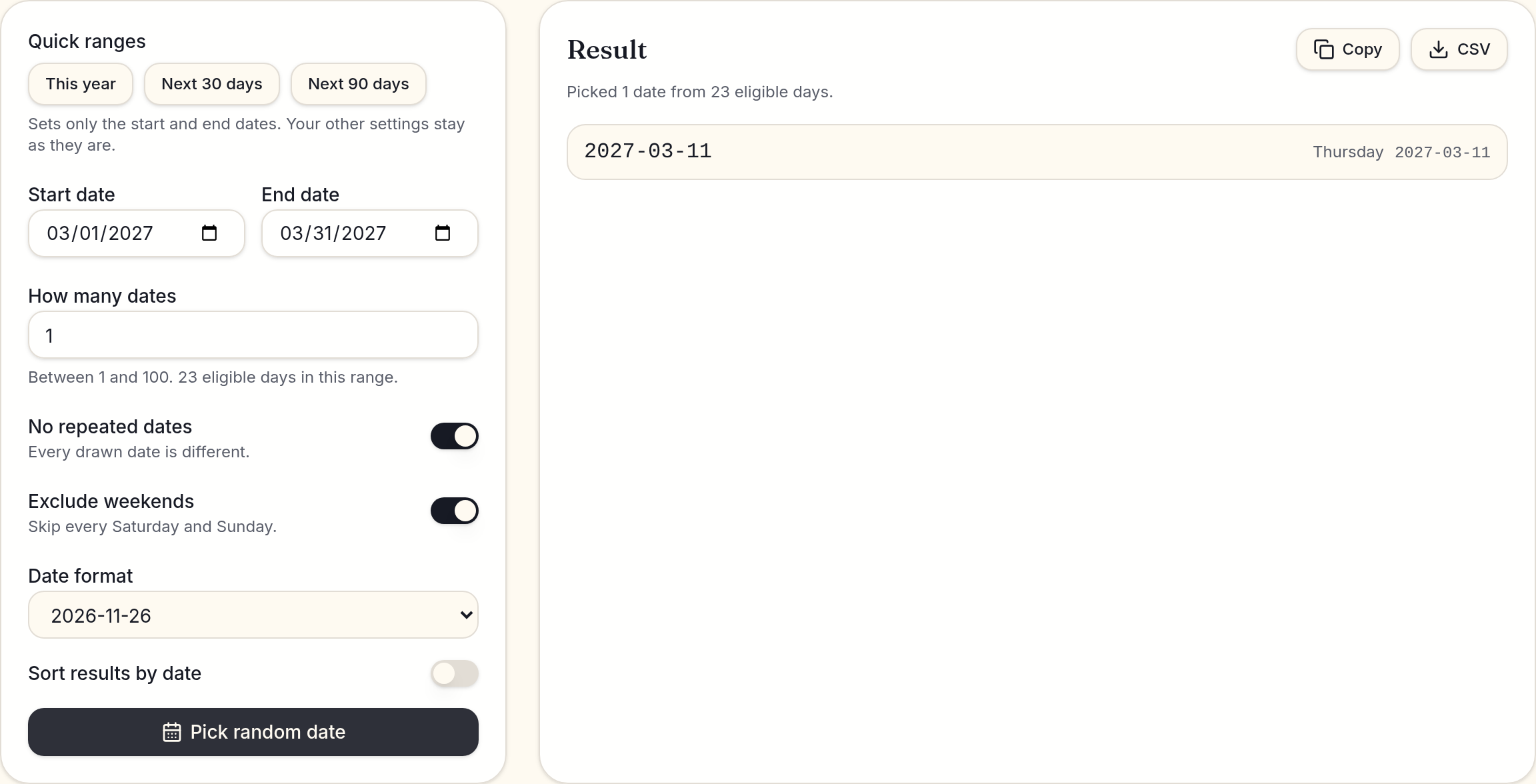
- Open the random date generator.
- Set the Start date and End date within a range of up to 200 years. Both ends can be picked, so a range from 1 to 31 March covers all 31 days.
- Decide about weekends. Turn Exclude weekends on if the date is for work, school or a business deadline. Leave Exclude weekends off for anything that can happen any day.
- Set How many dates to the number you need, from 1 to 100 per draw, and turn No repeated dates on if every date must be different.
- Press Pick random date (Pick random dates when requesting more than one), then copy the result or note it down with the time you drew it.
Common uses, and the settings for each
| Use | Range | Weekends included? | How many | Notes |
|---|---|---|---|---|
| Event or meetup date | The weeks you are free | Usually yes | 1 | Draw a few backups in case the first clashes |
| Spot checks and audits | The period under review | No, for working-day records | 5 to 20, no repeats | Draw before the period ends, so no one can prepare for the checked days |
| Who presents on which day | Term or sprint dates | No | One per person, no repeats | Pair the dates with names using the list randomizer |
| Date night or challenge day | Next month | Yes | 1 to 4 | Keep the draw secret for a surprise |
| Test data for software | Any span, including past dates | Yes | As many as needed, up to 100 per draw | Include 29 February and month ends to catch bugs |
| Writing and games | A story's year or era | Yes | 1 | A random date stops every scene happening on a Monday |
For spot checks especially, a random date protects you: if anyone later asks why a particular day was checked, the honest answer is that a tool chose it, and you have the record.
Getting the range right
Most unfair date draws come from a badly set range, not a bad random tool. Four things to check:
- Count the days, not the months. "A random day in Q1" has 90 days in 2026, but February is shorter than January and March. Every day should get the same chance, which means months with more days come up more often. That is correct, not a bug.
- Leap years. In the Gregorian calendar a year divisible by 4 is a leap year, except century years, which are leap years only when divisible by 400 (timeanddate). So 2028 has a 29 February, and 2100 won't. A range that crosses February in a leap year has one extra day to draw from.
- Weekends change the odds. With Exclude weekends on, a four-week range has 20 possible dates, not 28. Decide before you draw, and tell people which rule you used.
- Say which time zone. "The draw date is 3 March" means the same day everywhere, but a deadline at midnight does not. If people in different countries are involved, state the time zone with the date.
Other ways to pick a random date
| Method | Fair? | The catch |
|---|---|---|
| Random date generator | Yes | None, if it uses a good random source and you set the range carefully |
| Pick a random month, then a random day | No | Days in short months come up more often than days in long months |
| Roll dice or draw numbers from a hat | Yes, if done well | Slow, hard to record, and a 31-day month needs more than one die |
| Spreadsheet formula | Yes | Easy to get the range off by one; the result changes every time the sheet recalculates, so write it down |
| Choose "at random" in your head | No | Our choices cluster on familiar dates, and nobody else can check them |
The month-first method is the most common trap. With a random month and then a random day in it, each February day has a 1 in 336 chance (12 months × 28 days), while each January day has 1 in 372 (12 × 31). That makes every February date about 11% more likely to be drawn than a January one.
FAQ
Is every date in the range equally likely? On a well-built generator, yes: each day in the range has the same chance. With Exclude weekends switched on, each weekday has the same chance and weekend days have none.
Can I get the same date twice? Only if you allow repeats. For assigning dates to people, turn No repeated dates on so every date is used once.
How do I pick a random date of birth for test data? Set the range to the ages you need. For adults aged 18 to 65, start the range one day after the date 66 years ago, and end it on the date 18 years ago. Include 29 February in the range to test how your system handles leap days.
How do I prove the date was chosen at random? Note the range, the settings and the time of the draw, and take a screenshot of the result. For anything that matters, draw in front of the people affected or record your screen.
Sources
- Gregorian calendar and the leap year rules (timeanddate.com)
- Is an online wheel spinner really random? (PickFairly fairness test)
About the author
I’m Mujafet Osmani, founder of PickFairly, based in North Macedonia. I build easy-to-use online tools that solve everyday problems. I started PickFairly because I believe people deserve better tools than the ones that already exist, and that challenge is what drives me to keep improving it.